AccidentClaimsGuide.com · Car Accident Claims · March 2026 · 10 min read
This content is for informational purposes only and does not constitute legal advice. If you have been injured in an accident, consult a licensed attorney in your state for guidance specific to your situation.
The minutes and hours immediately following a car accident are the most important period in the entire personal injury claims process — not because the legal complexity is highest in that window, but because the evidence that exists in that window is the most valuable evidence available and because the decisions made in that window either protect or permanently compromise the claim that follows. The claimant who handles the accident scene correctly arrives at the claims process with a strong evidentiary foundation. The claimant who makes the common mistakes in the immediate aftermath — moving vehicles before documentation, speaking to the other driver about fault, declining medical attention because they feel fine — arrives at the claims process with gaps that the insurance company exploits throughout the negotiation.
Most people who are involved in a car accident have never been trained in what to do — the driver’s education that taught them how to operate a vehicle said nothing about what happens when the vehicle is involved in a collision. The sequence below is the preparation that most people wish they had before their first serious accident rather than after it.
The First Two Minutes: Safety and Emergency Response
The actions that occur in the first two minutes after a collision determine whether the accident scene produces additional injuries before the primary incident is addressed — and prioritizing safety over documentation in this window is the correct sequence even though documentation is the priority in the minutes that follow.
Moving to safety is the first action when the collision has occurred in a location that creates ongoing danger — a highway lane, a blind curve, or any position where remaining in place creates risk of additional collision. The vehicles that can be safely moved without losing evidence value should be moved to the shoulder or a safe location. The vehicles that are too severely damaged to move should be left in place with hazard lights activated while the occupants move to the roadside.
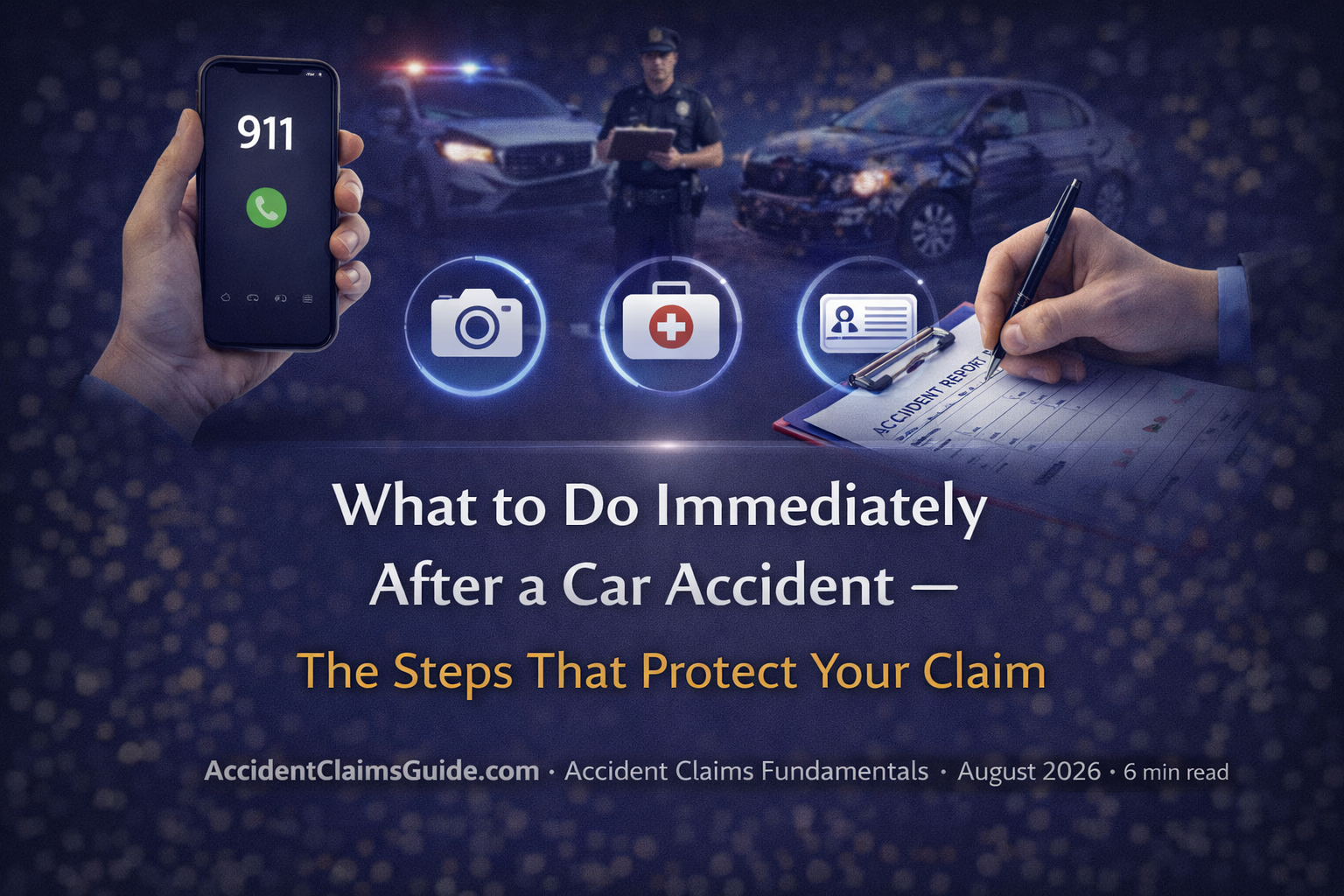
Calling 911 is the second immediate action — both to request emergency medical assistance if anyone is injured and to request law enforcement to the scene. The police report that a responding officer generates is one of the most valuable pieces of evidence in a personal injury claim — documenting the scene, recording the parties’ accounts of the accident, noting any citations issued, and creating an official record of the incident that the insurance company uses in its investigation. In many jurisdictions, law enforcement is required to respond to accidents involving injuries or significant property damage — but even in jurisdictions where response is discretionary, requesting police presence at the scene is worth the wait for the documentation value the police report provides.
Checking for injuries among all vehicle occupants is the third immediate action — assessing the condition of everyone involved in the accident and communicating clearly with the 911 dispatcher about the nature and severity of any injuries. The adrenaline response that most accident victims experience in the immediate aftermath frequently masks pain and injury symptoms that become apparent in the hours and days following the collision — which is why reporting any potential symptoms to the dispatcher, rather than minimizing them in the moment, produces a more accurate initial record.
The Documentation Phase: Everything Before the Scene Changes
The documentation phase begins as soon as the immediate safety concerns are addressed — and the thoroughness of the documentation performed at the scene directly determines the quality of the evidence available throughout the claims process.
The photographic and video documentation that a smartphone makes possible in 2026 should be as comprehensive as the scene allows — covering every angle of every vehicle involved in the collision, the damage patterns on each vehicle, the final resting position of each vehicle before any movement, the road conditions at the collision point including any skid marks, debris, or road hazards, the traffic control devices visible from the collision point including traffic lights and stop signs, and the broader accident scene showing the relationship between the vehicles and the road environment. The video walkthrough that narrates the scene — describing what is visible at each position — creates a documentary record that photographs alone don’t fully replicate.
The specific documentation targets that produce the most valuable evidence include the other vehicle’s license plate — photographed immediately in case the vehicle is moved before other information is exchanged, the damage patterns on both vehicles that establish the point of impact and the force of the collision, any visible injuries on the occupants of either vehicle, and any environmental conditions — rain, ice, poor visibility, road defects — that contributed to the accident.
The evidence that most commonly disappears before it is documented is the skid mark evidence — the tire marks on the road that establish braking distance, vehicle speed, and the sequence of events before the collision. Skid marks are visible immediately after the accident and fade within hours to days depending on weather and traffic conditions. Photographing the skid marks from multiple angles and distances, with reference objects that establish scale, preserves evidence that accident reconstruction experts use to establish vehicle speeds and the mechanics of the collision.
Information Exchange: What to Collect and What Not to Say
The information exchange with the other driver is a critical step that most drivers approach incorrectly — either failing to collect all of the information needed for the claims process or saying things at the scene that the insurance company later uses against the claim.
The information that must be collected from every other driver involved in the collision includes the full legal name, current address, phone number, driver’s license number and issuing state, license plate number and vehicle registration, and insurance company name and policy number. The insurance card that drivers are required to carry provides most of this information — photographing both sides of the insurance card ensures the policy number and effective dates are captured accurately.
The information that should be collected from witnesses includes the full name, phone number, and email address of every person who observed the accident from a position that provided a meaningful view of the events. The witness who saw the collision from a nearby vehicle or from a sidewalk or parking lot position has information that may never be available again if the contact information is not collected at the scene. The brief note about what the witness observed — what they saw before the collision, the sequence of events, the positions of the vehicles — supplements the contact information and helps identify which witnesses have the most valuable accounts.
The statement that should never be made at the accident scene is any admission of fault — including the reflexive apology that many people express after an accident because it feels like the socially appropriate response to a distressing situation. “I’m sorry” at an accident scene is not a legal admission of negligence, but it is a statement that the insurance company records in its claim notes and that the other driver’s attorney may attempt to use as evidence of fault acknowledgment in subsequent litigation. The correct communication approach at the accident scene is factual rather than evaluative — exchanging information, describing observations about the collision, and expressing concern for anyone who was injured without making statements about who was at fault or what caused the accident.
Medical Attention: The Decision That Affects Both Health and Claim
The medical attention decision at or immediately following the accident scene is the decision that most significantly affects the long-term outcome of both the physical recovery and the personal injury claim — and the most common mistake is declining medical attention at the scene because the injured person feels fine in the immediate aftermath of the collision.
The adrenaline and shock response that most accident victims experience immediately after a collision is a physiological state that masks pain and injury symptoms — producing the subjective experience of feeling uninjured even when significant injuries are present. The soft tissue injuries, concussions, spinal injuries, and internal injuries that produce no immediate symptoms but that develop fully over the hours and days following the collision are the injuries that most commonly go undetected at the scene and that most significantly compromise the subsequent personal injury claim when the injured person declined medical attention based on their immediate post-accident subjective assessment.
Accepting emergency medical evaluation at the scene when paramedics respond — rather than declining treatment because the symptoms aren’t immediately severe — creates the medical documentation that establishes the connection between the accident and the injuries that develop in subsequent days. The paramedic report that documents the claimant’s condition at the scene, the symptoms reported, and the treatment provided is among the most valuable early medical documentation in a personal injury claim — because it was created immediately after the accident by a medical professional who examined the claimant while the acute effects of the collision were present.
The follow-up medical appointment within twenty-four to forty-eight hours of the accident is essential even for claimants who felt well enough to decline emergency treatment at the scene — because the symptom development that occurs as the adrenaline response fades frequently reveals injuries that weren’t apparent immediately. The medical record from the follow-up appointment that documents the delayed symptom onset establishes both the injury and its connection to the accident within a timeframe that the insurance company cannot credibly argue reflects an unrelated subsequent event.
The Insurance Notification That Should Follow Promptly
The insurance company notification that the claimant’s own policy requires after an accident should occur within twenty-four hours — a timing requirement that most insurance policies include as a condition of coverage and that protects the claimant’s access to their own policy benefits regardless of fault determinations.
The notification to the claimant’s own insurer should be factual and limited — describing the accident circumstances, the parties involved, the injuries reported, and the property damage observed without providing a recorded statement or making any determination of fault. The claimant’s own insurance company has a different relationship with the claim than the at-fault driver’s insurer — but the communication principles that protect the claim are similar regardless of which insurer is being notified.
The notification to the at-fault driver’s insurance company should be approached more cautiously — because the at-fault driver’s insurer is an adversary in the claims process rather than the claimant’s own representative. Notifying the at-fault insurer of the accident is appropriate and necessary — but providing a recorded statement, agreeing to a quick settlement before the medical picture is established, or signing any documents without understanding their legal effect are actions that the at-fault insurer may request but that the claimant is not required to provide and that typically serve the insurer’s interests rather than the claimant’s.
The Days Following the Accident: Building the Evidence Foundation
The days immediately following the accident are the period when the evidence foundation for the personal injury claim is built or lost — and the specific actions taken during this period produce the documentation that supports the claim throughout the negotiation and, if necessary, the litigation that follows.
The injury journal that begins the day after the accident — a daily written record of symptoms, pain levels, functional limitations, and the impact of the injuries on daily activities — creates the contemporaneous documentation of the pain and suffering experience that the non-economic damages calculation depends on. The insurance company’s claims evaluation software assigns values to pain and suffering based on the injury type and the treatment duration — but the specific pain and suffering documentation that a detailed injury journal provides is evidence that supplements the software’s algorithmic assessment with a human account of the actual experience.
The preservation of all accident-related documents — the police report, the medical bills, the vehicle repair estimates, the rental car receipts, the pay stubs that document the lost wages, and any communication from the insurance companies — creates the organized record that the damages calculation requires. The claimant who preserves every document from the date of the accident arrives at the settlement negotiation with the complete economic damages picture. The claimant who discards documents or fails to organize them arrives at the negotiation unable to substantiate components of the claim that the documentation would have supported.
Taking the right steps after a car accident lays the foundation — but understanding specifically how much a car accident claim is worth given the specific injuries and circumstances is the next question that every accident victim needs to answer before evaluating any settlement offer. Our guide on how much is my car accident claim worth — the factors that determine your settlement covers the specific valuation methodology that personal injury attorneys and insurance companies use to calculate the value of car accident claims, including the factors that produce the highest and lowest settlement ranges for comparable injuries.
Recently involved in a car accident and trying to determine whether the actions taken at the scene and in the days following adequately protected the claim — or preparing to handle an accident correctly in the future and wanting to understand which of the steps above are most critical when time and circumstances at the scene limit what can be done? Describe the specific situation and which steps were or weren’t completed. The specific gaps in the immediate aftermath documentation often have remedies that can partially recover the evidentiary value that the initial steps would have produced.
Leave a Reply