AccidentClaimsGuide.com · Workplace Accident Claims · March 2026 · 8 min read
The workplace accident that produces a successful workers compensation claim is not random — it follows patterns that are specific enough to the industry, the job function, and the workplace conditions that understanding those patterns serves two distinct purposes simultaneously. For the worker who has already been injured, understanding the accident category that applies to their situation identifies the specific evidence, the specific documentation, and the specific legal theories that most effectively support the claim. For the worker who hasn’t been injured, understanding the most common accident types and the conditions that produce them provides the situational awareness that allows identifying and reporting hazards before they produce the injury that makes the claims process relevant.
The Occupational Safety and Health Administration’s annual data and the National Safety Council’s injury statistics consistently identify the same accident categories as the most frequent sources of workplace injury — and the patterns in that data are specific enough to produce actionable guidance for workers in the industries and job functions where each accident type is most prevalent.
Falls: The Most Consistently Frequent Workplace Accident Category
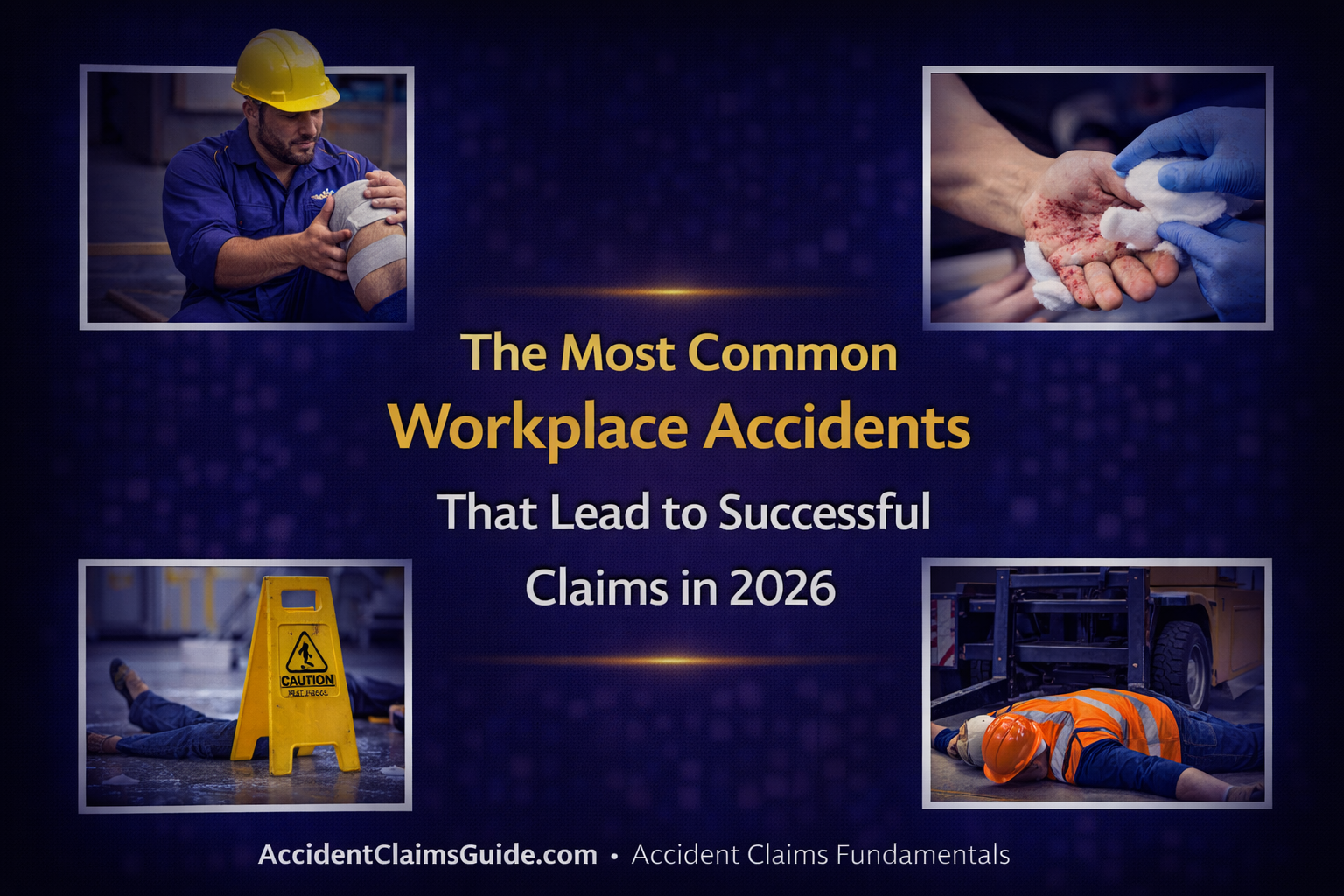
Falls are the leading cause of workplace fatalities in the construction industry and the leading cause of non-fatal workplace injuries across all industries — a dual distinction that reflects both the frequency of fall events and the severity of the injuries they produce. The fall accident category encompasses two distinct sub-types that the workers compensation system and the personal injury law that sometimes supplements it treat differently — falls from elevation and falls on the same level.
Falls from elevation — from ladders, scaffolding, roofs, elevated platforms, and other structures — produce the most severe injuries in the fall category and the most significant workers compensation claims. The construction worker who falls from scaffolding, the maintenance worker who falls from a ladder, and the warehouse worker who falls from a mezzanine are all experiencing the elevation fall scenario that produces traumatic brain injuries, spinal injuries, and fractures that generate workers compensation claims with both medical expense components and significant permanent disability components.
The OSHA fall protection standards that govern elevated work in construction — requiring fall protection at heights of six feet and above — are the regulatory framework that the third-party claim against the general contractor or property owner most commonly invokes when fall injuries occur from inadequate fall protection. The scaffolding collapse, the ladder without adequate footing, and the unguarded roof opening are all OSHA violation scenarios that simultaneously produce workers compensation claims against the employer and potential third-party negligence claims against the party responsible for the fall protection failure.
Falls on the same level — slip and fall accidents on wet floors, trip and fall accidents on uneven surfaces, and falls caused by cluttered walkways or inadequate lighting — are the most common fall scenario in non-construction industries. The retail worker who slips on a freshly mopped floor without adequate warning signs, the office worker who trips over a damaged carpet edge, and the warehouse worker who falls on an oil-slicked floor are all experiencing the same-level fall scenario that produces soft tissue injuries, fractures, and head injuries with workers compensation claims that succeed when the hazardous condition is documented at the time of the incident.
Overexertion Injuries: The Category That Most Consistently Goes Undocumented
Overexertion injuries — the musculoskeletal injuries that result from lifting, pushing, pulling, carrying, throwing, holding, or any other physical effort that exceeds the worker’s musculoskeletal capacity — are the most common non-fatal workplace injury category across all industries and the category most consistently underdocumented at the time of injury because the onset is frequently gradual rather than sudden.
The acute overexertion injury — the back strain that occurs during a specific lifting event, the shoulder injury that occurs during a single heavy push, and the knee injury that occurs during a specific carrying task — produces the most clearly documentable workers compensation claim because the injury has an identifiable incident date, a specific mechanism, and an immediate symptom onset that establishes the workplace connection. The worker who immediately reports the specific incident, seeks medical treatment within twenty-four hours, and documents the specific task being performed when the injury occurred has created the contemporaneous record that supports the acute overexertion claim effectively.
The cumulative trauma overexertion injury — the carpal tunnel syndrome that develops from years of repetitive keyboard use, the rotator cuff tear that develops from repetitive overhead reaching, and the lumbar disc herniation that develops from years of repeated lifting — is the overexertion injury that most commonly goes undocumented and underclaimed because the gradual onset makes it difficult to identify the specific workplace incident that the workers compensation claim requires. The occupational disease provisions that most states include in their workers compensation systems address cumulative trauma injuries by treating them as occupational diseases rather than specific incidents — using the date of diagnosis or the date the worker knew the condition was work-related as the reporting date rather than requiring identification of a specific incident.
The ergonomic hazard documentation that supports cumulative trauma workers compensation claims includes the job task analysis that identifies the specific repetitive motions or postural demands that the worker performed, the frequency and duration of the hazardous exposures, and the medical evidence that connects the diagnosed condition to the documented occupational exposures. The physician who specifically attributes the carpal tunnel syndrome to the documented keyboard use provides the medical causation opinion that the workers compensation claim requires when the condition results from cumulative exposure rather than a specific incident.
Struck-By Accidents: The High-Severity Category in Construction and Manufacturing
The struck-by accident — any workplace injury resulting from contact with a moving object — is the second leading cause of construction fatalities and a significant source of serious workplace injuries in manufacturing, warehousing, and transportation. The struck-by category encompasses the falling object, the flying object, the swinging object, and the rolling object — each producing injuries whose severity reflects the mass and velocity of the object involved.
Falling object struck-by accidents — the construction worker struck by a tool dropped from an elevated work platform, the warehouse worker struck by an item falling from inadequately secured racking, and the manufacturing worker struck by a component ejected from a machine — produce traumatic brain injuries, spinal injuries, and fractures whose severity reflects the height from which the object fell and the mass of the object involved. The falling object accident in a construction context implicates OSHA’s falling object protection standards — which require toeboards, safety nets, or other means of preventing object falls to lower levels — and frequently supports a third-party claim against the general contractor responsible for the site’s falling object protection program.
Flying object struck-by accidents — the grinding wheel fragment that strikes a manufacturing worker, the nail gun discharge that strikes a construction worker, and the pressurized fluid ejection that strikes a maintenance worker — produce injuries whose severity reflects the velocity and mass of the projectile. The flying object accident that results from a defective tool or machine component simultaneously produces a workers compensation claim against the employer and a product liability claim against the manufacturer of the defective component — the two-claim structure that often produces the most significant total recovery for serious struck-by injuries.
Caught-In and Caught-Between Accidents: The Machine Guarding Failures
Caught-in accidents — where a worker’s body part is caught in or between objects — are the third leading cause of construction fatalities and the most severe category of machine-related workplace injuries in manufacturing. The unguarded machine that catches a worker’s hand, the power transmission equipment that catches a worker’s clothing, and the trench collapse that catches an excavation worker are all caught-in scenarios that produce amputations, crush injuries, and fatalities.
The machine guarding failure that produces a caught-in injury is simultaneously an OSHA violation — under OSHA’s machine guarding standards requiring physical guards on all machinery with moving parts that create amputation hazards — and the factual basis for both the workers compensation claim and the potential third-party product liability claim against the machine manufacturer if the inadequate guarding reflected a design defect rather than employer removal of an adequate factory guard.
The trench collapse that catches construction workers performing excavation is the caught-between scenario that OSHA’s excavation standards specifically address — requiring protective systems including sloping, shoring, or trench boxes for excavations five feet deep or greater in most soils. The trench collapse that occurs without adequate protective systems is simultaneously a catastrophic injury event and an OSHA violation that supports the personal injury claim against the general contractor or excavation contractor whose failure to implement the required protective systems caused the collapse.
Workplace Violence: The Underreported Injury Category
Workplace violence — intentional acts of physical violence against workers — is a workplace injury category that workers compensation covers when the violence arises out of and in the course of employment, and that most injured workers don’t immediately recognize as a workers compensation claim because the injury mechanism is different from the equipment or environmental hazard scenarios that most workers associate with workplace injury.
The workers compensation coverage for workplace violence injuries applies when the violence has a connection to the employment — the retail worker assaulted during a robbery, the healthcare worker assaulted by a patient, and the social services worker assaulted while conducting a client visit are all experiencing workplace violence within the scope of workers compensation coverage because the employment placed them in the circumstances that produced the violent encounter.
The civil third-party claim that workplace violence sometimes supports — against the perpetrator directly when assets make collection practical, or against a third-party property owner whose negligent security failures allowed the violence to occur — supplements the workers compensation coverage with the pain and suffering and full wage replacement that the workers compensation system doesn’t provide. The nightclub employee assaulted because the employer failed to provide adequate security personnel has both a workers compensation claim against the employer and potentially a third-party negligence claim against the property owner whose security failures created the conditions for the assault.
Occupational Disease Claims: The Long-Latency Conditions That Workers Often Don’t Recognize as Compensable
Occupational diseases — illnesses that develop from workplace exposures over extended periods — represent a workers compensation claim category that most affected workers don’t pursue because they don’t recognize that their medical condition has a compensable workplace cause. The mesothelioma from asbestos exposure, the coal workers’ pneumoconiosis from coal dust inhalation, the silicosis from silica dust exposure, and the noise-induced hearing loss from prolonged exposure to excessive workplace noise are all occupational diseases with long latency periods between exposure and diagnosis that obscure the workplace connection for many affected workers.
The occupational disease workers compensation claim requires establishing the causal connection between the workplace exposures and the diagnosed disease — which for long-latency diseases like mesothelioma means documenting the historical asbestos exposure that occurred decades before the diagnosis. The occupational history that a treating physician or occupational medicine specialist compiles identifies the specific workplace exposures, their duration and intensity, and their connection to the specific disease mechanism — providing the medical causation foundation that the occupational disease claim requires.
The toxic tort claim that some occupational disease scenarios support — against the manufacturers of the hazardous substances that caused the disease rather than against the employer alone — can produce compensation significantly exceeding the workers compensation benefits. The asbestos product manufacturers who knew of mesothelioma risks and concealed them while continuing to market asbestos-containing products have faced billions of dollars in toxic tort liability — which has produced compensation for mesothelioma victims that the workers compensation system alone could never have provided.
The Documentation Practices That Make Workplace Accident Claims Most Successful
The workplace accident claims that produce the most successful outcomes across every accident category share specific documentation practices that apply regardless of the specific type of accident involved. The immediate incident report that captures the specific facts of the accident — the date, time, location, task being performed, the specific mechanism of injury, and the witnesses present — creates the contemporaneous record that supports the workers compensation claim and that establishes the factual foundation for any third-party claim.
The workplace condition documentation that captures the specific hazard that caused the accident — the photograph of the wet floor without warning signs, the measurement of the scaffolding height without fall protection, the documentation of the missing machine guard — provides the objective evidence that establishes both the hazard existence and the employer’s or third-party’s failure to address it. The hazard documentation that is captured immediately after the accident, before the employer has the opportunity to correct the condition, is more valuable than the documentation captured days later when the corrective action may have altered the evidence.
Understanding the most common workplace accident types completes the contextual picture of workplace injury claims — knowing specifically how much a workplace injury claim is worth across different injury types and different circumstances is the valuation knowledge that allows every injured worker to evaluate the adequacy of any settlement or benefit offer they receive. Our guide on how much is a workplace injury claim worth — the compensation calculation most workers don’t know covers the specific valuation methodology for workers compensation benefits and third-party claims across the most common workplace injury scenarios.
This content is for informational purposes only and does not constitute legal advice. If you have been injured in an accident, consult a licensed attorney in your state for guidance specific to your situation.
Leave a Reply